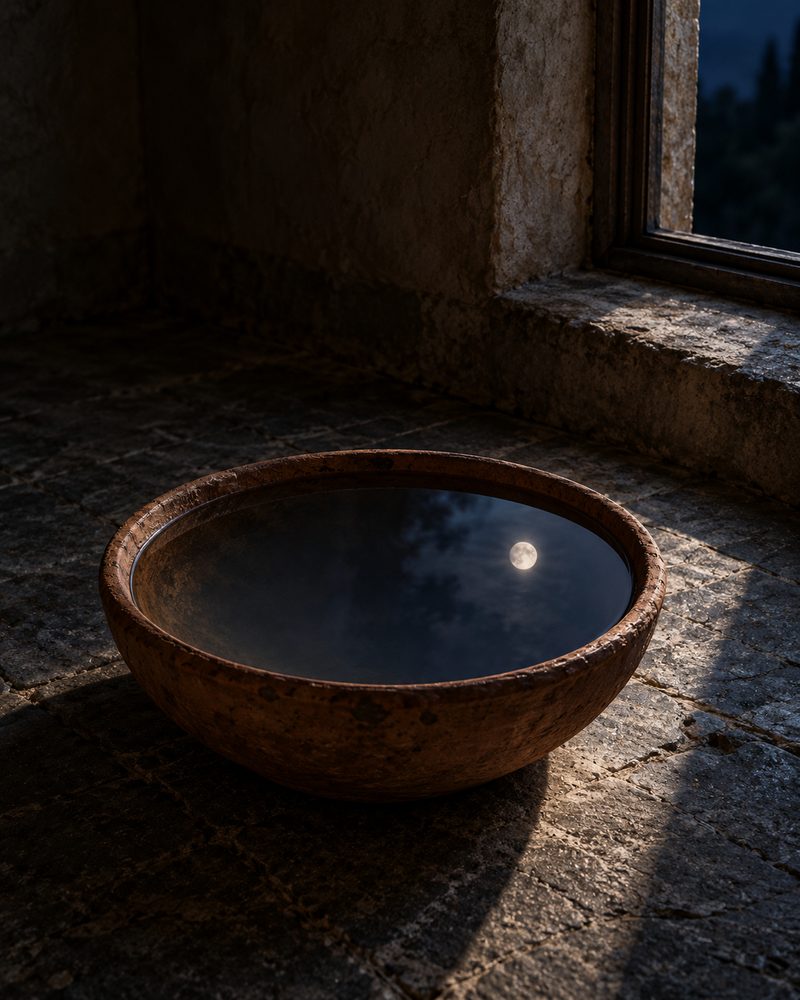
Contemplative prayer is prayer without many words. Instead of asking for something or reciting a text, you rest in silence and attention, open to God, to the sacred, or simply to what is. It is one of the oldest forms of prayer, and one of the simplest to begin.
The short version: sit still, let one word or one breath anchor you, and when thoughts come, return gently to the anchor. Eight minutes are enough to start.
What is contemplative prayer?
Most prayer uses words: we thank, ask, praise or lament. Contemplative prayer goes one step further and lets the words fall away. The Christian mystics called it "resting in God". Other traditions speak of stillness, presence or pure attention. What they share is a movement from talking to listening.
Contemplative prayer is not a technique for emptying the mind. Thoughts will come, and that is fine. The practice is the returning: each time you notice you have drifted, you come back, without judging yourself.
Where it comes from
- The Desert Fathers and Mothers (Egypt, from the 3rd and 4th centuries) withdrew into silence and repeated short prayers throughout the day.
- The Jesus Prayer of the Eastern Orthodox tradition, "Lord Jesus Christ, Son of God, have mercy on me", is repeated slowly with the breath until it becomes a kind of inner stillness.
- The Cloud of Unknowing, written anonymously in 14th-century England, teaches that God can be reached by love rather than by thought ("by love may He be gotten and holden; but by thought never"), with a single short word to hold one's attention.
- Teresa of Ávila and John of the Cross, 16th-century Spanish Carmelites, described contemplation as a friendship and as a "loving attention" to God.
- Lectio divina, described in the 12th century by the Carthusian Guigo II, moves through four steps: reading, meditation, prayer and finally contemplation.
Contemplative prayer and centering prayer
Centering prayer is a modern form of contemplative prayer. It was developed in the 1970s by the Trappist monks William Meninger, Basil Pennington and Thomas Keating at St. Joseph's Abbey in Spencer, Massachusetts, drawing on The Cloud of Unknowing.
In centering prayer you choose a short "sacred word", such as peace, love or Abba, as a sign of your intention. You sit with eyes closed, and whenever you become aware of thoughts, you return ever so gently to the sacred word. The usual recommendation is twenty minutes, twice a day.
So the difference is one of scope: contemplative prayer is the whole family of silent, receptive prayer; centering prayer is one specific method within it. Our step-by-step guide to centering prayer explains the method in detail.
Contemplative prayer and meditation
The two look alike from the outside: someone sits in silence. The difference lies in the direction. Meditation, especially in its secular forms, often trains attention itself. Contemplative prayer understands the silence as a relationship, with God or with something greater than oneself. In practice many people move freely between the two. Our Sunday practice welcomes both: meditation for peace or prayer, your way.
How to begin: eight minutes of contemplative prayer
- Choose a time and a place. Every Sunday at 8 PM is a good anchor, because others are sitting at the same moment.
- Choose an anchor. One word (peace, shalom, salam, shanti) or your breath.
- Sit comfortably, back upright, eyes closed or lowered.
- Arrive. Take one slow breath. Say your word inwardly once.
- Rest. Let the silence be. When thoughts come, notice them and return to your word, gently, like placing a feather on cotton.
- Widen. In the last minutes, bring one person to mind, then your city, then the world. Hold them in the same silence.
- Close. A few moments of stillness, then a small thank you.
A soft bell helps, so you do not need to look at a clock. The eight-minute timer on our home page rings one at the beginning and one at the end.
Common difficulties
"My mind will not stop." It is not supposed to. Returning is the prayer. A session with a hundred returns is not a failed session.
"I feel nothing." Contemplative traditions insist that feelings are not the measure. John of the Cross wrote at length about times of dryness. Keep the appointment anyway.
"I do not have time." Eight minutes once a week is a real beginning. It can grow from there.
Questions about contemplative prayer
What is contemplative prayer in simple words?
Silent prayer in which you stop talking and simply rest in attention to God or to the present moment, returning gently whenever your thoughts drift.
Is contemplative prayer biblical?
Christians who practise it point to verses such as "Be still, and know that I am God" (Psalm 46:10) and to Jesus withdrawing to pray alone. The practice itself was shaped by later Christian tradition, from the Desert Fathers to modern Trappist monks.
How long should contemplative prayer last?
Centering prayer traditionally recommends twenty minutes twice a day. For a beginning, eight minutes are enough. Regularity matters more than length.
Can I practise contemplative prayer if I am not Christian?
Yes. The practice of silent, receptive attention exists in many traditions, and people without a religion can practise it as stillness. In our Sunday circle everyone prays or meditates their own way.